















Bali Nyepi Day of silence rules

If you plan to stay in Bali on March 19th, you’ll get to experience something that only happens here once a year: Bali Nyepi Day, also known as the Day of Silence.
And trust me, it’s so completely different from what Bali usually is. In Nyepi, Bali is completely in a shutdown mode. No honking sounds, no loud noises, no traffic. All you can hear is the beachwave rolling in (if you’re near the coast) and birds chirping like they finally got the stage to themselves.
And, to learn more about Bali’s Day of Silence, and to respect it properly, there are a few important rules you should know.
What Is Nyepi and Why Does It Matter
Nyepi day is a sacred Hindu holiday for Balinese Hindus. It’s the New Year in the Balinese Saka calendar (you may hear people say the Balinese Saka calendar, Balinese Hindu calendar, or simply the Balinese calendar). While many cultures celebrate “new year celebrations” with loud parties and fireworks, Nyepi, celebrated in Bali, is the opposite: a day of silence focused on self-reflection, balance, and renewal.
This isn’t “a tourist event.” It’s a sacred time in Balinese Hinduism and Balinese culture, practiced across Balinese villages, including deeply traditional Hindu Balinese villages where community rituals are central to life.
What to Prepare Before Nyepi Day

A lot of people don’t enjoy Nyepi because they don’t prepare beforehand, that’s why it ends up feeling boring when you’re stuck inside and suddenly realize there’s “nothing to do.” So, if you want Nyepi to feel peaceful instead of painful, here’s what to prep before the Day of Silence so you’re comfortable, fed, and happily entertained.
1) Stock up 1–2 days before (future you will thank you).
Grab everything you’ll want for a full stay-in day: food, snacks, drinking water, coffee/tea, and any essential meds. On Nyepi Day, Bali basically hits pause, and shops/markets are closed, so it’s not the day to realize you’re out of toothpaste or instant noodles.
2) Pull out cash early.
Don’t assume you can just “find an ATM later.” A lot of ATMs may be shut down by around 6:00 PM the day before Nyepi, so withdraw cash earlier to be safe.
3) Lock in your travel plan (because even the airport stops).
Book flights outside the 24-hour Nyepi window. Ngurah Rai Airport suspends flight operations for Nyepi. And if you’re already on the island, make sure you’re checked into your hotel/villa before it starts, because once Nyepi kicks in, you can’t roam around.
4) Download your entertainment like it’s a tiny “offline retreat.”
Here’s the thing, people don’t expect: for Nyepi, mobile data and internet services can be stopped for 24 hours. This applies to eSIMs in Bali as well, if they are connected to an Indonesian network provider. Some hotels keep Wi-Fi on (sometimes limited), and some don’t. So download your shows, save playlists offline, and pack a book or a simple game.
5) If you’re in a villa, pre-cook or keep it super simple.
Nyepi is meant to be quiet and minimal (even cooking). So if you’re not in a hotel with meals, prep food beforehand, think easy stuff you can reheat quickly or eat without a whole “MasterChef moment.”
The Nyepi Festival: What Happens Before Nyepi Begins
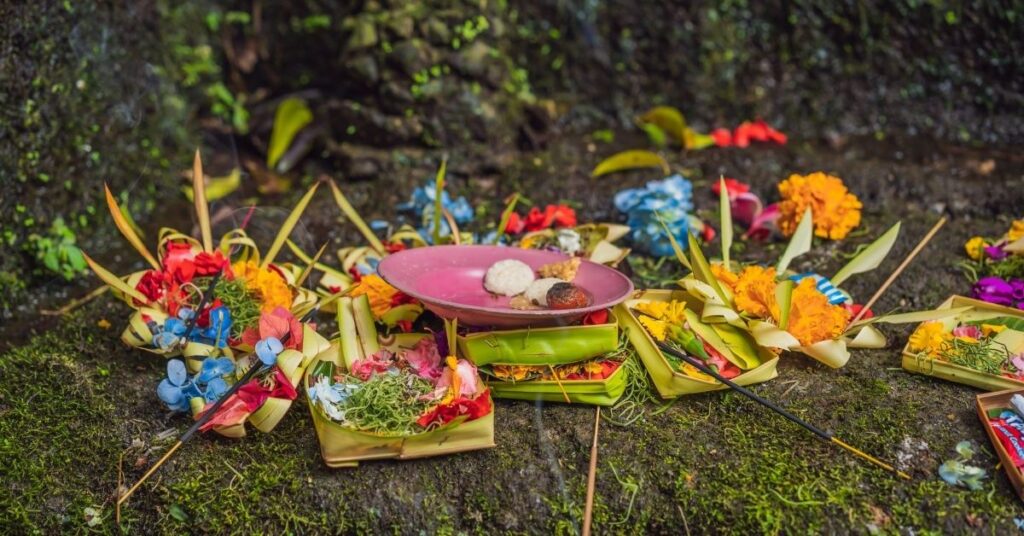
There are Nyepi rituals leading up to the silent day, and they help explain the meaning behind the Bali Nyepi day of silence rules.
In the days before Nyepi, you may see communities preparing offerings, wearing traditional attire, and gathering at temples. This is when Bali feels especially “alive” in a cultural way, less about tourist schedules, more about local rhythm.
Melasti Ritual and Purification Ceremony
One major pre-Nyepi tradition is the Melasti ritual, a purification ritual (or purification ceremony) where sacred items from temples are brought out in processions, often toward the sea. You may hear people refer to holy water because water plays a key role in cleansing and renewal.
During Melasti, you might see sacred objects and sacred temple objects carried carefully, with prayers, offerings, and sometimes traditional music. It’s solemn, organized, and deeply meaningful. If you watch, do it respectfully: keep distance, don’t block paths, and treat it like what it is, a sacred moment, not a photo opportunity.
Ogoh Ogoh Parade and Ngrupuk Ceremony

This is honestly my favorite event before Nyepi Day: the Ogoh-Ogoh parade.
The night before the Day of Silence, Bali gets loud in the coolest way, streets fill up, families come out, friends gather, and you’ll see these giant Ogoh-Ogoh statues being carried around like a moving art show.
And there’s a real reason Balinese people make Ogoh-Ogoh: they’re meant to represent Bhuta Kala, basically the chaotic, negative forces (people often describe them as “evil spirits” or bad vibes) that can throw life out of balance.
Building them is a community effort (especially for the youth), and parading them through the neighborhood is symbolic, like “bringing the negativity out into the open.” In many places, the statues are ritually destroyed or burned afterward to symbolize cleansing, so the island can start the new year feeling purified and reset.
If you want the easiest “you’ll definitely see a lot” Ogoh-Ogoh experience, go to central Denpasar (around Puputan Badung / Catur Muka), it’s usually the biggest, most packed spot. If you’re more into a cultural, performance-y vibe, Ubud center is a great pick.
But honestly? The most authentic (and least stressful) move is to ask your hotel or villa, “Where’s the nearest banjar parade tonight?”, because there’s often one happening right near where you’re staying. Quick tips: go a bit early, wear comfy shoes, bring water, and plan your way back before roads get chaotic (and keep your phone charged, just in case).
Nyepi Day Rules: Catur Brata Penyepian
When Nyepi begins, the rules are real and apply throughout the day in Bali. The core framework is called Catur Brata Penyepian, and it shapes the Nyepi day rules that tourists hear about.
In simple terms, the Bali Nyepi Day of Silence rules mean the silence observed is island-wide:
- No going out on the streets
- No entertainment outside
- No loud noise
- Lights are minimized at night
- Work and travel pause
- The goal is quiet contemplation and self-reflection
So, you’ll be staying in your accommodation, usually your hotel room or villa. Many hotels prepare for this and offer special Nyepi packages, meals, quiet room service, and gentle activities that stay within the rules. So, you definitely need to check your hotel’s regulations during Nyepi Day.
From my own experience, Nyepi wasn’t “boring”, it was just different. The peaceful atmosphere felt almost unreal, as if the whole island were exhaling together. It’s one of the rare times travel gives you true stillness.
Traditional Security Guards and Local Community Enforcement
You may see or hear about traditional security guards (often called pecalang). They help protect sacred time and maintain order, so complete silence is respected. This isn’t about tourists being “policed” for fun; it’s about safeguarding a sacred Hindu holiday that matters deeply to the Balinese people and the local community.
If you follow your hotel’s guidance and stay inside, you won’t have problems. The simplest rule is: don’t test the boundaries.
Only Exceptions and Life-Threatening Conditions
There are only exceptions for serious emergencies. Hotels still operate in limited ways, and essential emergency services still exist. But don’t assume “exceptions” apply to normal tourist needs. They’re for situations like life-threatening conditions or urgent medical care.
If you need help, contact your hotel staff first. They’ll know what’s allowed and how to handle it properly.
Arrive Early and Expect the Entire Island to Stop
If you’re traveling around Nyepi, arrive early at your hotel before restrictions start. Don’t plan last-minute transfers. Remember: the whole island shuts down. The entire day is quiet. The entire island participates. And yes, even the airport closes. That’s why it’s famous: Bali’s Day of Silence is one of the few times on Earth a major destination pauses completely.
A bonus many travelers don’t expect: reduced light pollution can make the night sky feel clearer (weather permitting). The quiet at night can be the most intense part because you realize how much modern life usually hums in the background.
Respecting Non-Hindu Residents and Non-Hindus

Nyepi is led by Balinese Hindus, but it affects everyone living on the island, including non-Hindu residents, non-Hindus, and visitors. The respectful approach is simple: you are sharing space during a sacred time, so you match the tone of the place you’re in.
If you treat Nyepi as an inconvenience, it will feel annoying. If you embrace Nyepi, it can feel like a reset you didn’t know you needed.
After Nyepi: Renewal, Connection, and Local Traditions
After the silent day, Bali gradually returns to life. Many people reconnect with a sense of renewal, families visit, neighbors greet each other, and the “new year” feeling becomes more social.
You might also hear about a local kissing ritual, often described as a playful mass kissing event in certain communities. It’s not part of the main island-wide Nyepi day rules, and it’s not something tourists should treat like a show. Think of it as one of many local traditions that can exist around the broader year celebrations, interesting, specific, and rooted in the community context.
How to Experience Nyepi in Bali the Right Way
If you want the real value of experiencing Nyepi, aim for the full arc:
- Watch the lead-up rituals respectfully (like the Melasti ritual)
- Experience the energy of the ogoh ogoh night (the parade with giant ogoh ogoh statues)
- Then let the silence do its work on Nyepi day
Nyepi in Bali is not about checking boxes. It’s about feeling the contrast: from noise to stillness, from outward life to inward life, from distraction to self-reflection. For one entire day, the island chooses quiet on purpose, and that shared commitment is what makes it powerful.
Ready to Apply or Extend Your Visa?
Let our visa specialists handle your application.





 English
  Bahasa Indonesia
  Español
  Italiano
  Français
  日本語
日本語  Nederlands
  繁體中文
繁體中文  한국어
한국어  Norsk bokmål
  Svenska
  Dansk
Dansk  Türkçe
  Polski
  香港中文
香港中文  简体中文
简体中文  Українська
  Русский
  Bahasa Melayu