












Sådan ansøger du om globalt statsborgerskab i Indonesien (GCI)

In December 2025, the Indonesian government announced a new program called Global Citizenship of Indonesia (GCI). The name sounds like a passport or “dual citizenship,” right? But here’s the key point up front: GCI is not Indonesian citizenship. It’s an unlimited (no end date) stay permit for certain foreigners with strong ties to Indonesia, such as former Indonesian citizens and their families. So, GCI does not grant Indonesian nationality, political rights, or voting rights.
Why does this matter? Indonesia does not recognise dual citizenship for adults. So if someone becomes a citizen of another country, they usually can’t keep Indonesian citizenship either. Under Indonesian law, this restriction has long posed a challenge for the diaspora, and GCI is Indonesia’s approach to addressing it. GCI is modelled after India’s Overseas Citizenship of India (OCI) visa, but does not grant the same legal standing or rights.
So… what is GCI?
According to Indonesia’s Directorate General of Immigration, GCI is a policy that gives an “izin tinggal tetap tanpa batas waktu”, a permanent stay permit with no time limit, for eligible foreign nationals who have blood/family/historical ties to Indonesia.
The immigration ministry is responsible for regulating and implementing the GCI program, and all official information about GCI is published on government portals.
On the official Immigration site, the “Global Citizen of Indonesia” page says GCI is designed for diaspora and cross-national families, and it highlights:
- indefinite stay,
- instant processing on arrivalog
- minimal reporting every five years (and it states “without fee” for that reporting).
The GCI category determines eligibility and requirements for applicants, including fee structures, ownership rights, and other conditions as part of Indonesia’s broader system for foreign residence and investment options.
That’s the promise. The details you’ll actually deal with come down to the visa categories og krav listed on the official visa pages.
GCI is specifically designed for individuals with confirmed Indonesian biological or ancestral ties. The GCI program was officially announced on 19 November 2025 and will launch on January 26, 2026.
Why did Indonesia create GCI now?

Indonesia has long engaged in public debate about dual citizenship, particularly among diaspora communities. Reuters links the timing to “brain drain” concerns: Indonesians moving abroad for better opportunities and then losing Indonesian citizenship. Reuters also notes Immigration data showing that nearly 4,000 Indonesians became Singapore citizens from 2019 to 2022, a figure officials cited as part of the broader talent-migration issue.
The government also openly compares GCI to India’s Overseas Citizenship of India (OCI) model, a “citizenship-like” residency status for diaspora members, without a passport.
Indonesia’s approach can also be compared to Australia’s immigration and dual-citizenship policies, which provide pathways for foreign nationals and expatriates to obtain residency or special status while maintaining their original citizenship. GCI allows individuals to retain their foreign citizenship while gaining long-term residency rights in Indonesia; it is not a pathway to naturalization or Indonesian citizenship.
The GCI program aims to attract talent and investment, modernize governance towards a more open immigration framework, and enhance Indonesia’s global interconnectedness to support economic growth.
Who can apply (Eligible Applicants)?
Immigration’s official press release lists these groups as eligible to apply for GCI, with family ties (including those from mixed marriage families) being central to eligibility:
- Tidligere indonesiske statsborgere (ex-WNI), also referred to as former citizens
- Descendants of former Indonesian citizens up to the second degree
- Legal spouses of Indonesian citizens (WNI) or ex-WNI, including foreign spouses
- Children from legal marriages between an Indonesian citizen and a foreign national, highlighting mixed marriage families
GCI is designed for individuals with confirmed Indonesian biological or ancestral ties.
At the same time, the public “GCI” visa list shown on the official Immigration site focuses on the E32 series (more on that below).
Who is excluded?
The press release also says the permit does not apply to foreign nationals who:
- are from countries that were once part of Indonesia’s territory,
- are involved in separatismeller
- have backgrounds as civil servants, intelligence, or foreign military abroad (as stated in the release).
You’ll also see similar exclusion language listed on the official E32 visa pages themselves.
The 4 GCI visa types you’ll see on the official site (E32 series)
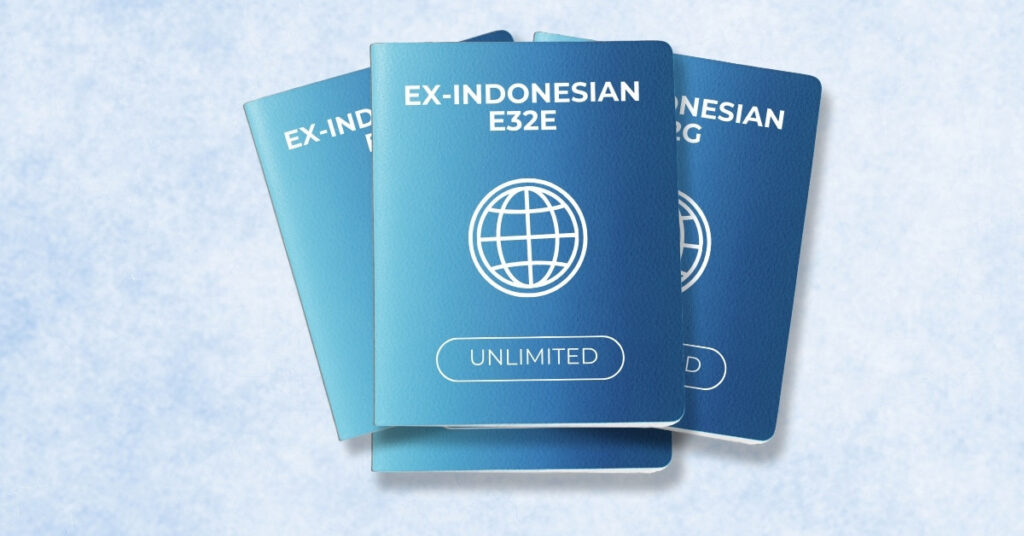
On Immigration’s official “Global Citizen of Indonesia” page, GCI is linked to four visa categories: E32E, E32F, E32G, and E32H. The GCI category is a classification within Indonesia’s immigration framework that determines eligibility, fee structures, and requirements for foreign nationals seeking residence or investment options.
Here’s what each one means in normal language:
1) E32E, Repatriation, Permanent Stay (for ex-Indonesians)
This is for foreign nationals who used to be Indonesian citizens and want to settle in Indonesia.
The official page lists key requirements like:
- passport valid for mindst 6 måneder,
- a recent photo,
- proof you can support yourself, and
- immigration guarantee documents.
Applicants must also provide financial proof, such as evidence of income and living expenses, to meet the financial criteria set by immigration authorities.
It also lists financial benchmarks, including:
- Statement of commitment that must be accomplished within 90 (ninety) days from the date of arrival, such as:
- Purchase Indonesian government bonds, at least US$10,000 (ten thousand US dollars); or
- Purchase shares in publicly listed companies in Indonesia, at least US$10,000 (ten thousand US dollars); or
- Purchase mutual funds in Indonesia, at least US$10,000 (ten thousand US dollars); or
- Place funds in the form of deposits in state-owned banks, at least US$10,000 (ten thousand US dollars); or
- Purchase property in the form of flats or apartments in Indonesia, at least US$100,000 (one hundred thousand US dollars or equivalent.
- Proof that the documents show the foreigner was previously an Indonesian citizen, such as:
- Identity card (KTP);
- Birth certificate;
- Family card;
- Passport of the Republic of Indonesia;
- Diploma, or
- Proof of ownership of the house or land.
The financial commitment for former Indonesian citizens is $5,000, which can be fulfilled through deposits, bonds, shares, or mutual funds in Indonesia. The GCI application also requires a PNBP fee of IDR 34,800,000.
2) E32G, Descendant of ex-Indonesians, Permanent Stay
This is for descendants of ex-Indonesians up to the second degree who want to settle in Indonesia.
The baseline requirements are similar (passport 6+ months, photo, proof of funds, etc.).
The official page also lists:
- Statement of commitment for the descendants of ex-Indonesian citizens at most of the first degree that must be accomplished within 90 (ninety) days from the date of arrival, such as:
- Purchase Indonesian government bonds, at least US$25,000 (twenty-five thousand US dollars); or
- Purchase shares in publicly listed companies in Indonesia, at least US$25,000 (twenty-five thousand US dollars); or
- Purchase mutual funds in Indonesia, at least US$25,000 (twenty-five thousand US dollars); or
- Place funds in the form of deposits in state-owned banks, at least US$25,000 (twenty-five thousand US dollars); or
- Purchase property in the form of flats or apartments in Indonesia, at least US$250,000 two hundred fifty thousand US dollars) or equivalent
- Statement of commitment for the descendants of ex-Indonesian citizens at most of the second degree that must be accomplished within 90 (ninety) days from the date of arrival, such as:
- Purchase Indonesian government bonds, at least US$100,000 (one hundred thousand US dollars); or
- Purchase shares in publicly listed companies in Indonesia, at least US$100,000 (one hundred thousand US dollars); or
- Purchase mutual funds in Indonesia, at least US$100,000 (one hundred thousand US dollars); or
- Place funds in the form of deposits in state-owned banks, at least US$100,000 (one hundred thousand US dollars); or
- Purchase property in the form of flats or apartments in Indonesia, at least US$1,000,000 (one million US dollars) or equivalent
- Proof that the documents show the foreigner was previously an Indonesian citizen, such as:
- Identity card (KTP);
- Proof of family relationship with an ex-Indonesian citizen, among others:
- Familiekort
- Book of marriage or certificate of marriage issued by the ministry or authorized institution
- Other documents that prove and explain the family relationship with former Indonesian citizens
- Curriculum vitae;
- Proof of income, at least.
- US$15,000 (fifteen thousand US dollars) per year; or
- US$1,500 (one thousand five hundred US dollars) per months
- Proof of income, at least:
- US$15,000 (fifteen thousand US dollars) per year or
- US$1,500 (one thousand five hundred US dollars) per month
The financial commitment for first-generation descendants is $10,000, and for second-generation descendants is $25,000. This financial commitment can be fulfilled through deposits, bonds, shares, or mutual funds in Indonesia.
3) E32F, Repatriation, “Special Skills”
This is still in the repatriation lane, but the guarantee section is different. The official E32F page lists:
- Valid Nationality Passport with at least 6 (six) months.
- Proof of living expenses of at least US$2000 (two thousand dollars) or equivalent.
- Proof of guarantee from the Guarantor, which is the central government.
- Latest color photograph.
- Curriculum Vitae.
- An invitation letter from the government, which explains the hiring of a foreigner who is an ex-Indonesian citizen with special talents.
- Proof that the documents show the foreigner was previously an Indonesian citizen, such as:
- Identity card (KTP);
- Birth certificate;
- Family card;
- Passport of the Republic of Indonesia;
- Diploma, or
- Proof of ownership of the house or land.
- Proof of income, at least:
- US$15,000 (fifteen thousand US dollars) per year; or
- US$1,500 (one thousand five hundred US dollars) per month;
4) E32H, Descendant, “Special Skills”
Like E32F, this one also lists:
- Travel Itinerary.
- An invitation letter from the government, which explains the hiring of a foreigner who is an ex-Indonesian citizen with special talents.
- Proof that the documents show a foreigner had a second-degree relationship with an ex-Indonesian citizen, such as:
- Birth certificate;
- Proof of family relationship with ex-Indonesian citizens in the following :
- Family card;
- book of marriage or certificate of marriage issued by the ministry or authorized institution;
- other documents that prove and explain the family relationship with former Indonesian citizens
- Curriculum vitae;
- Proof of income, at least:
- US$15,000 (fifteen thousand US dollars) per year; or
- US$1,500 (one thousand five hundred US dollars) per month;
Documents you’ll likely need (general checklist)
These come straight from the official E32 pages and the government’s application flow. Exact documents can vary by category, but expect the core items below.
- A valid passport (the E32 pages list minimum 6 months validity; a valid passport is essential for all applicants)
- A recent color passport photo
- Financial proof as evidence of financial stability or support (proof of funds/living expenses and income; see E32E/E32G amounts)
- Immigration guarantee documents (investment/property commitment, or government invitation for “special skills”)
- “Special purpose” documents showing your background/ties (the pages list examples like KTP, KK, birth certificate, passport, diploma, land certificate)
Always consult official information on government websites for the most up-to-date requirements.
How to apply (step-by-step, in normal human language)

Just like e-visa on arrival, you can also apply for GCI on the officiel immigrationshjemmeside.
Here’s the practical flow:
Step 1: Enter the official eVisa system and select the right purpose
Start on Indonesia’s official Immigration eVisa website and log in. On the visa-finder page, select your passport country/region, then choose Diaspora as your main purpose (and sub-purpose if it asks). This step matters because the GCI options appear under the Diaspora pathway; if you choose the wrong purpose, you may not see the E32 codes at all.
Step 2: Choose the correct GCI code (E32E / E32F / E32G / E32H)
Before you fill out anything, pick the visa code that matches your background. E32E is generally for ex-Indonesian citizens (ex-WNI), meaning you were previously Indonesian, and now you hold another citizenship. E32G is generally for descendants of ex-WNI, meaning you were never Indonesian yourself, but your parent or grandparent was Indonesian (up to second degree), and you can prove the family link.
Now the important warning: E32F and E32H are not “upgrades.” They are the særlige færdigheder routes, and they typically require a central government invitation/urgency letter as part of the immigration guarantee. So if you don’t already have that government-backed invitation path, E32F/H may not be realistic, and you should usually focus on E32E (ex-WNI) eller E32G (descendant) i stedet.
Quick “Which one am I?” guide (fast check):
If you can honestly say, “I used to be Indonesian, I had Indonesian documents, but I’m now a foreign citizen,” you’re usually an E32E case. If you can honestly say, “My parent/grandparent was Indonesian, but I have always been a foreign citizen,” you’re usually an E32G case. If you can say, “I’m ex-WNI/descendant and I have a central government invitation for special skills,” then E32F (ex-WNI) eller E32H (descendant) becomes the correct lane.
Step 3: Use the “Detail” page as your checklist, then fill the form carefully
After you select the code, open the visa Detail page first and treat it like a checklist. This page typically outlines the stay duration, cost, activities available, and required documents. Then fill in the application form: personal identity, passport information, and your address in Indonesia. Most delays happen because details don’t match (spelling differences, inconsistent names, unclear proof of ex-WNI/descendant status), so copy your passport information exactly and upload documents that clearly connect you to the eligibility category you selected.
Step 4: Pay, download your eVisa, and keep a complete file of your submission
Once your form and documents are complete, proceed to payment. After approval, download the eVisa and save it with your payment receipt and the documents you uploaded. Don’t treat payment as the finish line; some GCI paths may include commitments or compliance points on the Detail page. The safest approach is to apply only when you’re ready to meet the requirements listed under your specific E32 code.
Finally, follow the compliance rules after entry. Immigration’s GCI page emphasises “instant on arrival” processing and says reporting is only needed every five years, and it states that reporting has no fee.
Always refer to official information on the government portal for the latest updates and requirements.
Ofte stillede spørgsmål
Is GCI the same as Indonesian citizenship or an Indonesian passport?
No. The official Immigration page frames GCI as an unlimited stay permit (residency status), not nationality.
Do I have to renounce my current citizenship to get GCI?
No, Immigration explicitly says GCI lets you get an unlimited stay permit “tanpa harus menanggalkan kewarganegaraan” (without relinquishing your citizenship).
What’s the difference between the “Permanent Stay” and “Special Skills” versions (E32E/G vs E32F/H)?
The Special Skills versions (E32F/E32H) require a central government sponsor, and the immigration guarantee is an invitation/urgency letter from the central government. The Permanent Stay versions (E32E/E32G) list no sponsor and use financial “commitment” requirements as the immigration guarantee.
When did applications open, and when is it officially launching?
The Indonesian Immigration began accepting applications ahead of an official launch scheduled for 26 January 2026, and that applications were already under review in late December 2025.
Are there people who are not eligible even if they have Indonesian roots?
Yes. The E32 pages list exclusions such as:
- Nationals of countries that were once part of Indonesia’s territory
- Anyone currently/formerly serving as a civil servant, law enforcement, intelligence, or military abroad
- Anyone involved in separatism or actions against the national interest
The bottom line
GCI is Indonesia’s “middle path” between no dual citizenship og wanting the diaspora to stay connected. It’s framed as a way to let former Indonesians and certain family lines return and live in Indonesia long-term while keeping their foreign nationality.
Klar til at ansøge eller forlænge dit visum?
Lad vores visumspecialister håndtere din ansøgning.





 English
  Bahasa Indonesia
  Español
  Italiano
  Français
  日本語
日本語  Nederlands
  繁體中文
繁體中文  한국어
한국어  Norsk bokmål
  Svenska
  Dansk
Dansk  Türkçe
  Polski
  香港中文
香港中文  简体中文
简体中文  Українська
  Русский
  Bahasa Melayu